Productive Robotics
Welding Automation & Perception
Owned the welding process end to end — perception to arc.
The Problem
A welding cobot has to find the joint, follow it, and lay a controlled bead — then do it again across dozens of part geometries and welder hardware types. The application layer sits between a hard real-time motion core and a high-power welding process where timing and precision are safety-relevant.
The Approach
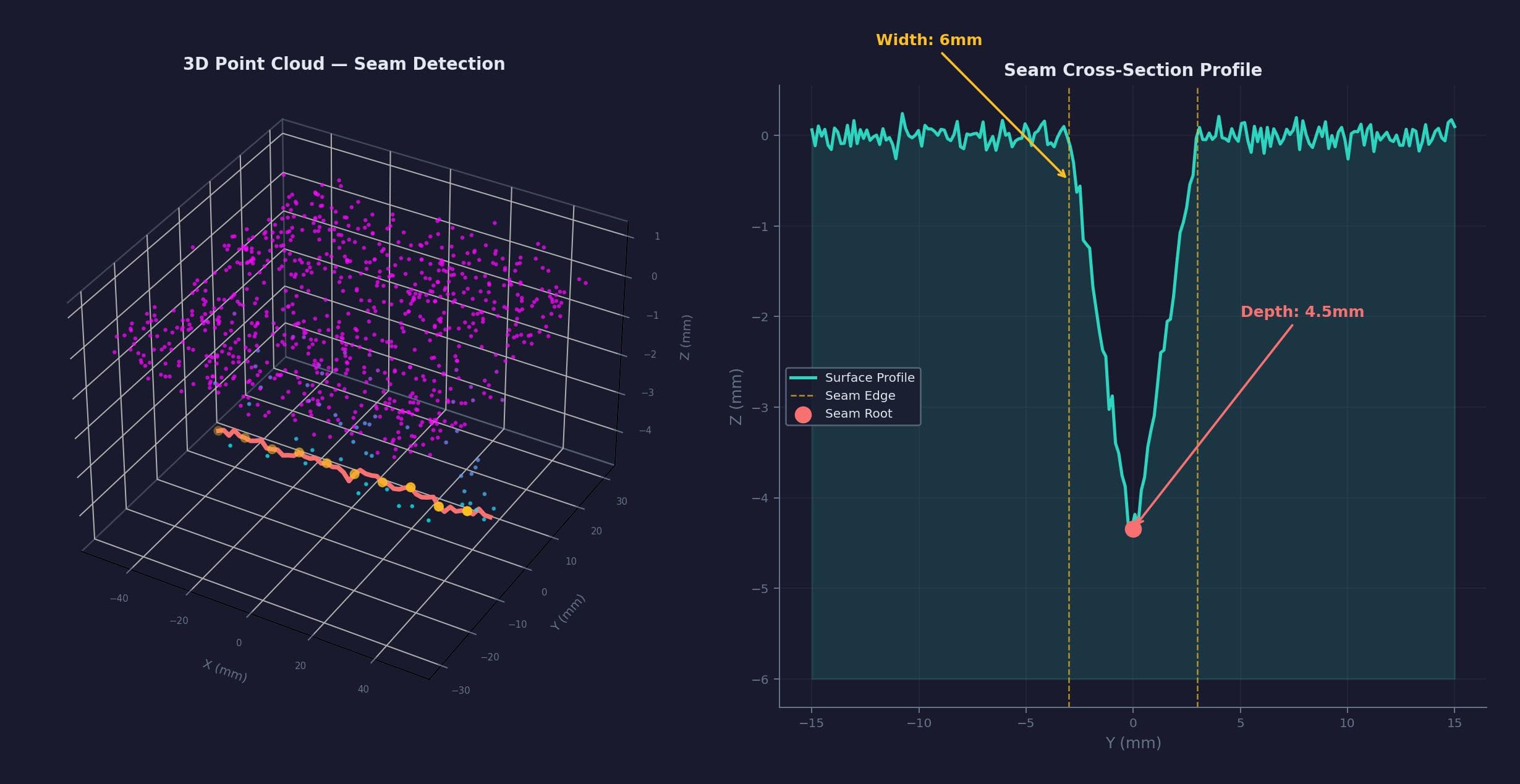
Owned the welding application end to end: a real-time weld-monitoring dashboard, live travel-speed control via path reparameterization (no replanning), a C++ EtherNet/IP CIP driver for the welder with packed binary I/O assemblies and high-rate telemetry, and a parametric weld-recipe system operators tune on the tablet. Built the motion patterns welding actually needs — wire-as-probe touch sensing and V-groove centering to find the joint, stitch and multipass sequencing to fill it, and a plasma-cutting mode — all driven from the same trajectory core through one hot-swappable driver supporting 7+ welder types. Added a 2026 AI-perception track: scan-native weld-seam detection from CAD B-rep topology and scanner occlusion physics, plus robot-mounted eye-in-hand 3D scanning with charuco calibration and mesh reconstruction.
The Outcome
The welder integration shipped in about three weeks — against a manufacturer estimate of more than a year — with a 12.5× telemetry improvement. Seam detection reaches 0.4 mm repeatability on real scans, mesh reconstruction lands at ~1 mm RMSE, and one B-rep classifier proved a customer's '10 seams' were actually press-brake bends before a single move was programmed.